Buying a Used Excavator: The Inspection Checklist Before You Transfer Money
7 min read
The right order for buying a used excavator is paperwork first, cold metal second, a test dig under load third, and money last. Most expensive mistakes come from running that sequence backwards: falling for the machine on the phone, skimming the walk-around, and treating the paperwork as a formality on handover day. This checklist is the field version, written to be worked through on site in about an hour. If you are still deciding whether the machine is even the right class for your work, start with what size excavator the work actually needs and come back with a shortlist.
Paperwork first: serial plate, PPSR and ownership
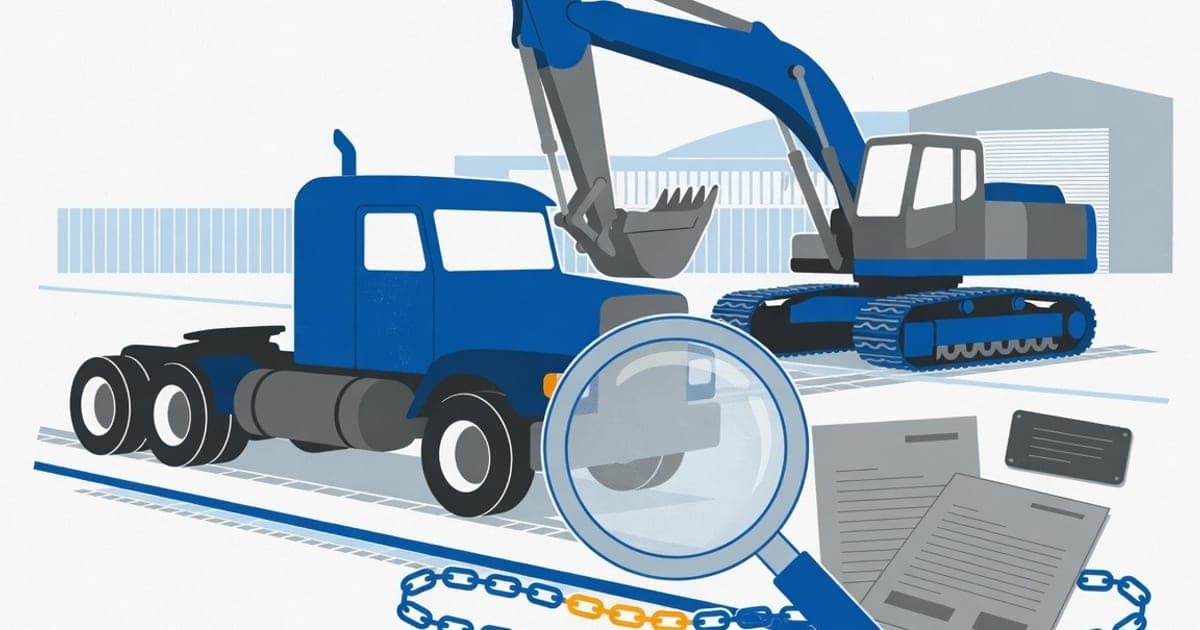
Before you touch a grease nipple, find the serial plate and photograph it. Then check the number character by character against whatever paperwork the seller has: invoice, finance payout letter, service records, insurance schedule. An excavator is not a road vehicle, so unless it is registered for road use it has no VIN and no rego to anchor its identity. The serial number is the identity.
Run a PPSR search on that serial number at ppsr.gov.au. It costs a couple of dollars and takes minutes. For road-registered vehicles you search by VIN; for plant and machinery you search by serial number, and this is the part buyers get wrong, because a search on the wrong identifier comes back clean and means nothing. If the machine has money owing against it, the financier's interest survives the sale. An encumbered machine can be repossessed from you even after you have paid the seller in full. The mechanics of the register, and what to do when a search shows a registration, are covered in how a PPSR check works for trucks and machinery.
Stolen plant is a real problem in Australia, and excavators are a favourite because they are valuable, mobile and identified by one small plate. Be suspicious of a plate that is missing, freshly riveted, painted over, or carries stamping that looks doubled or re-struck. Cross-check secondary markings where the manufacturer puts them: many machines carry the serial stamped into the chassis as well as on the plate, and component serials on the engine can be checked against the machine's records. A seller who cannot explain the machine's history, will not meet at a fixed address, or wants a deposit to hold a machine you have not seen is showing you the pattern described in our marketplace safety guidance. Walk.
Hours: what the meter tells you and what it does not
Read the hour meter, then stop believing it. Hour meters are replaced when dashes fail, and on some machines they can be swapped in minutes. What corroborates the meter is the paper trail: service invoices with hours written on them, oil sample reports, dealer inspection records. A machine showing 4,200 hours with a service sticker in the cab door reading 6,800 has told you everything you need to know about the seller.
Hours also mean different things in different lives. A 5 tonne machine that spent its life on hire has been operated by a hundred different people, most of them in a hurry. The same hours in one owner-operator's hands, greased daily, are a different machine. Ask who operated it, on what material, and why it is being sold, and see whether the answers match the wear you are about to inspect.
Undercarriage: measuring wear before you buy
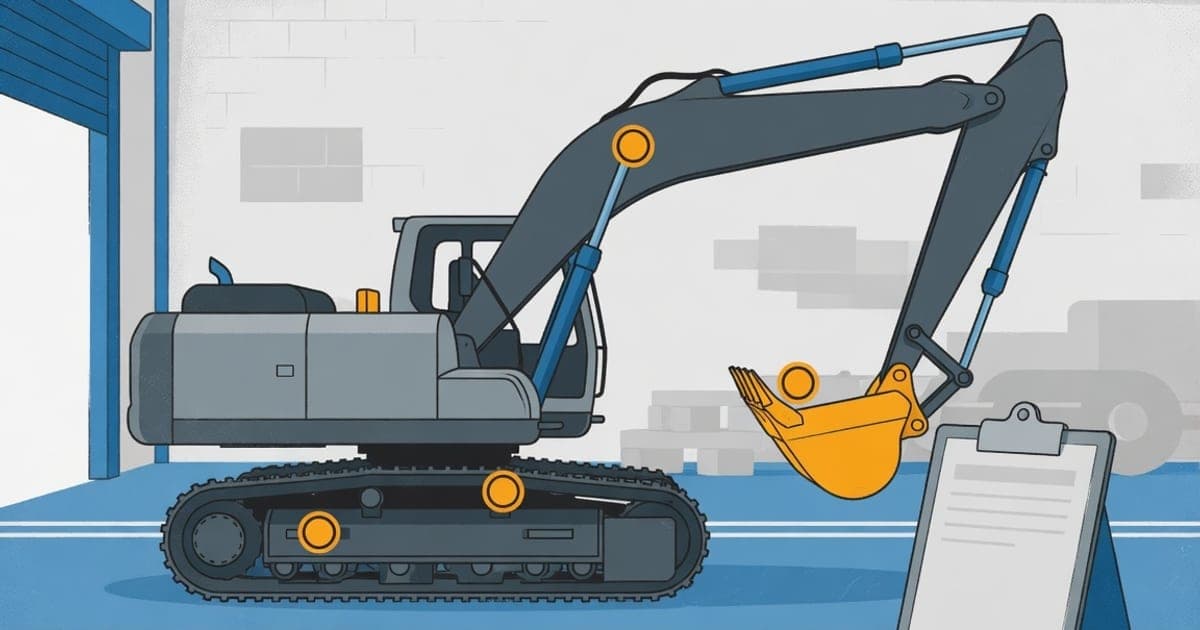
Undercarriage is the biggest hidden cost in a tracked machine, so it gets measured, not eyeballed. The process: look at the chain for stretch and sag, the condition of the track shoes or rubber tracks, the rollers and idlers for flat spots, ridges and weeping seals, and the sprockets for teeth that have gone from rounded to pointed. Wear is properly measured with gauges against the manufacturer's published wear limits, and a seller's claim of "80 percent undercarriage" without a measurement report behind it is a sales claim, not data. What the components are, how percentage wear is actually measured, and how to turn a reading into a price adjustment is its own subject, covered in excavator undercarriage wear and what replacement really costs. For the field visit, the job is simpler: photograph everything, note obvious wear, and make any offer conditional on a measured undercarriage report.
Hydraulics: drift, leaks, hose condition and cylinder scoring
Hydraulics are the second place the money hides. Work through:
- Cylinder rods. Sight down every rod for scoring, pitting and bend. A scored rod eats seals; a bent rod means the machine has been abused.
- Leaks. A film of oil and dust is normal on a working machine. Drips, wet hoses, and fresh oil runs are not. Look under the machine, around the swivel joint, and at the track tensioner.
- Hoses. Cracked, chafed or ballooned hoses are a re-hose bill. On an older machine a full re-hose is routine maintenance, but it belongs in your price.
- Drift test. Load the bucket, hold it off the ground, and watch. Then curl the bucket full and set the boom at half height and wait a few minutes. Cylinders that creep down under load have internal leakage past the seals, or a control valve problem. Either way it is money.
Drift is exactly the kind of fault that never appears in an unloaded driveway demo, which is why the test dig below is not optional.
Pins, bushes and slack in the boom and dipper
Grab the bucket and shake it hard side to side and up and down, then do the same at the dipper and boom joints. A little movement is normal life; clunking slop is worn pins and bushes, and on a machine that has been greased badly, every joint will be the same. Watch the joints while an operator works the controls in small movements: slack shows as a visible jump before the attachment moves. Pins and bushes are repairable, and some joints can be line bored and bushed back to spec, but it is workshop time on a machine that is not earning, so it prices into your offer. While you are there, check the bucket itself: cracked welds, worn teeth and adapters, and plate worn thin are all consumables, and a machine sold with a fleet of tired attachments is not the bargain the photo suggested.
Engine, cooling and the cold start
Insist on a genuinely cold start, and put your hand on the engine before it cranks to make sure nobody warmed it up before you arrived. Watch the exhaust: blue smoke that persists is oil, white that persists points at fuel or coolant, and heavy black under light load points at fuelling or air problems. Listen for knocks that change with revs. Then check the boring things that predict the next twelve months: oil level and condition, coolant colour and oil film in the header tank, a radiator core packed with dirt, perished belts, chafed wiring, and evidence of the machine having lived its life in mud to the top of the tracks. Let it reach temperature and hold it under load; a cooling system that only just copes empty will not cope in January.
Slew ring, tracks, final drives and the test dig
A test dig under load is the only honest way to see hydraulic drift, slew condition and final drive noise, so do not buy without one. Dig real ground, not the loosened pile beside the machine.
- Slew. Rotate the house both directions and listen for grinding or clunks from the slew ring and motor. Check for movement between house and undercarriage with the bucket anchored.
- Travel. Track the machine both directions and turn both ways. Whining, grinding or knocking from a final drive is one of the more expensive noises an excavator makes. Check both final drive oil levels if the seller allows; metal in the oil ends the conversation.
- Under load. Dig at working depth, load the bucket fully, lift and slew as the machine would work. Weak breakout, stalling functions, overheating hydraulics and drifting cylinders all show up here and nowhere else.
Walking away: the deal breakers
| Finding | Why it ends the deal |
|---|---|
| Serial plate missing, altered or mismatched to paperwork | Possible stolen plant; you can lose the machine and the money |
| PPSR registration the seller cannot or will not clear at settlement | The financier's interest survives your payment |
| Metal in a final drive or evidence of slew ring failure | Repair cost is a large share of machine value |
| Bent boom, dipper or evidence of chassis cracking and plated repairs | Structural abuse; everything else is suspect |
| Hour meter contradicted by service stickers or records | The one number you cannot verify is now unknown |
| Seller refuses a cold start or a loaded test dig | Assume the machine fails one of them |
None of these are negotiating points. They are exits.
Plenty of faults short of a deal breaker are simply money: undercarriage percentage, pins and bushes, hoses, a tired bucket. Price them against what used excavators are actually asking and make the offer with the repair list attached.
What to do next
Take this list to the machine, in this order, and let the machine fail early before you have spent a day on it. Compare a few machines rather than falling for the first: current stock is in the earthmoving and construction listings. And if the inspection talks you out of your own machine instead, that is information too: list it free with the hours, a photo of the serial plate area, and a recent undercarriage measurement, because the buyers worth having will ask for all three in the first message.