Roadranger vs Automated Manual: Which Truck Transmission Should You Buy?
7 min read
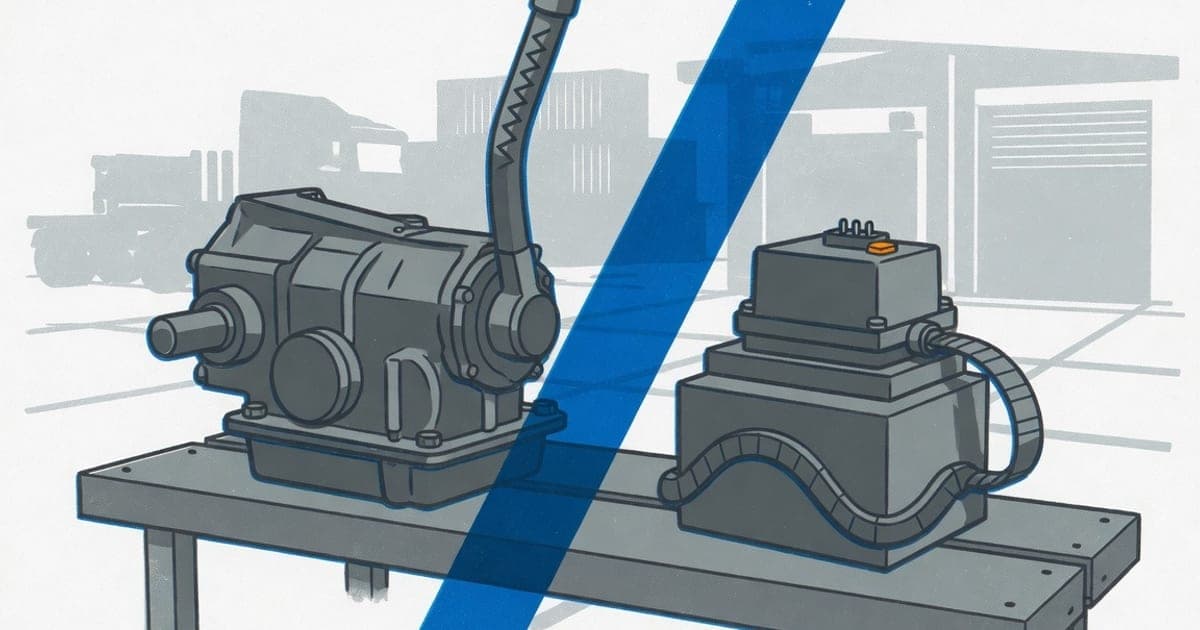
The transmission argument in Australian trucking is mostly settled at the fleet level and still very alive at the owner-driver level. Fleets buy automated manual transmissions because they can put almost any licensed driver in the seat; owner-drivers keep buying 18 speed Roadrangers because they trust them, can get them rebuilt anywhere, and often learned the trade on one. Neither camp is wrong. The right answer comes from four practical questions: who will drive the truck, what licence conditions those drivers carry, what the repair story looks like where you operate, and what the truck will be worth when you sell it. This post works through all four.
The three families: crash box, AMT and torque converter auto
Constant mesh manual, the Eaton Roadranger being the Australian archetype: a non-synchromesh gearbox shifted by matching engine revs to road speed, with a clutch used mainly for starting. Mechanically simple, immensely strong, and entirely dependent on the skill of the person driving it.
Automated manual transmission (AMT): a manual gearbox shifted by computer-controlled actuators, no clutch pedal. Volvo's I-Shift and Mack's mDRIVE, Scania's Opticruise, Daimler's DT12 and Eaton's UltraShift family are the names you will meet in listings. The modern generation is the default in new Australian linehaul trucks.
Torque converter automatic, Allison being the dominant name: a true automatic, no clutch at all, at home in vocational work, waste, agitators, buses and anything that lives in stop-start duty where clutches and AMT actuators live short lives.
How Roadranger gearing works and why 13 and 18 speed exist
A Roadranger multiplies a five-position shift pattern with a range change (low and high) and, on 13 and 18 speeds, a splitter that halves the step between gears. Heavy combinations need many small steps because a loaded road train or B-double cannot afford to lose momentum between gears: the 18 speed's close splits let the driver keep the engine in its narrow sweet band at any load and grade, which is why it remains the default in roadtrain and heavy vocational work. The trade is that rev-matching a constant mesh box is a genuine skill; driven well the box lasts, driven badly it is an expensive noise. How the gearbox choice interacts with diff gearing and tyre size is its own subject, covered in the diff ratio guide.
AMT: what changed and what operators report
Early AMTs earned a rough reputation, and operator commentary from the 2000s-era units is full of slow, indecisive shifting and expensive actuator faults. The current generation is a different conversation: operators report the modern I-Shift, mDRIVE and DT12 boxes as quick, smart with load and grade sensing, and easier on fuel and drivelines than the average human, which is consistent with why every major manufacturer now fits them as standard. Attribute those as operator reports rather than measurements, and note that manufacturer fuel economy claims are marketing until proven in your work, so do not price a truck on them.
What operators also report: when a modern AMT does fault, diagnosis and repair concentrate at dealers and specialists, because the transmission is an electronic system wrapped around a gearbox. Clutch packs, actuators and calibrations are the recurring cost items, and software access matters as much as spanners, the same integration trade-off described in the engine comparison for integrated drivelines.
Driver availability: the argument that decides most fleets
Here is the blunt commercial reality: the pool of drivers who can drive a truck is far larger than the pool who can drive a Roadranger properly, and the second pool is ageing. A fleet running AMTs can recruit from the whole licensed market, put a new driver to work with minimal transmission training, and stop budgeting for the clutches and gear sets that learners consume. An owner-driver who is the only person in the seat can ignore all of that and buy whatever their left arm prefers. Decide which operation you are before the salesman decides for you. If the truck will ever need a relief driver at short notice, the AMT's recruiting advantage is worth real money.
The licence condition nobody mentions
The detail that ambushes buyers: heavy vehicle licences in Australia carry conditions based on the transmission you were tested in. The general structure, and confirm the current detail with your state road authority before relying on it, is that passing your heavy vehicle test in an automatic or automated transmission restricts you from driving constant mesh (crash box) trucks, a test in a synchromesh manual typically clears synchro and automatic but still not constant mesh, and only a test in a constant mesh vehicle clears you for everything including the Roadranger. Condition codes and exact wording vary by state; Transport for NSW, VicRoads, Queensland's Department of Transport and Main Roads and their counterparts publish theirs, and the code prints on the licence itself.
The consequences cut both ways. A driver licensed in an AMT cannot legally jump into your Roadranger truck, which quietly shrinks the relief-driver pool for manual trucks and feeds the fleet drift to AMTs. And a buyer upgrading through the licence classes should think hard about which transmission to test in, because the condition follows the licence, not the truck. The classes themselves, and how the upgrade ladder works, are covered in the truck licence guide.
Repair and rebuild cost compared
The Roadranger's ace is its ecosystem. Australia has a deep bench of driveline specialists who have rebuilt these boxes for decades; exchange units, parts and expertise are everywhere, downtime is short, and there is no software gatekeeping any of it. We are deliberately not printing rebuild dollar figures without dated quotes behind them; the honest statement is structural: a Roadranger rebuild is a commodity service priced by open competition, an AMT repair is a specialist or dealer event, and a used AMT truck should be bought with its clutch and actuator service history in the folder, priced with a dealer's diagnosis if anything is doubtful. Torque converter Allisons in vocational trucks sit in their own world: long service lives in the right duty, specialist attention when they do need it. Whichever family you run, the gearbox's interaction with the rest of the driveline decides swap options later, and what actually interchanges is worth reading before you assume any replacement is a bolt-in.
Resale value in the Australian used market
In the early August 2026 scan of trucksales.com.au, machines4u.com.au and Gumtree listings used across our price guides, both buyer pools are visibly alive. Late-model AMT trucks dominate the volume, priced keenly because fleets turn them over in numbers, which makes them the value buy going in and the commodity sale going out. Manual Roadranger trucks are scarcer in late-model form, and tidy examples carry confident asking prices to a devoted owner-driver audience, particularly in roadtrain and vocational configurations. Treat that as observed market behaviour on asking prices, not a promise: the manual-capable buyer pool is deep today and demographically narrowing, so a manual truck held for many years is a bet on how fast that pool shrinks.
Which to buy for which operation
| Your operation | Sensible default | Why |
|---|---|---|
| Fleet, mixed or rotating drivers | AMT | Whole-market recruiting, licence conditions rarely bite, consistent driving style |
| Owner-driver, linehaul | Either; buy condition and history | Your licence and preference decide; the market supports both |
| Roadtrain and heavy vocational | 18 speed Roadranger still common | Close splits under heavy load, field-repairable ecosystem |
| Waste, agitator, severe stop-start | Torque converter automatic | Clutchless launch survives duty that kills clutches and actuators |
What to do next
Answer the four questions, who drives it, what their licences allow, who fixes it where you run, and who buys it after you, and the transmission usually picks itself. Then shop the actual market: filter the current truck listings for both transmission types in your configuration and compare asking prices with your own eyes. Selling a truck? The transmission is a headline detail, so list it free with the exact box (RTLO 18 speed, I-Shift, DT12, Allison) named in the title line, the clutch or actuator history stated, and watch the right buyer pool find it.
Licence condition structure described above varies in detail by state and changes over time; confirm current condition codes with your state or territory road authority before booking a test or hiring a driver. Market observations describe asking prices on the named sites in early August 2026.