Kenworth vs Volvo vs Scania: Which Prime Mover Actually Suits Australian Work?
6 min read
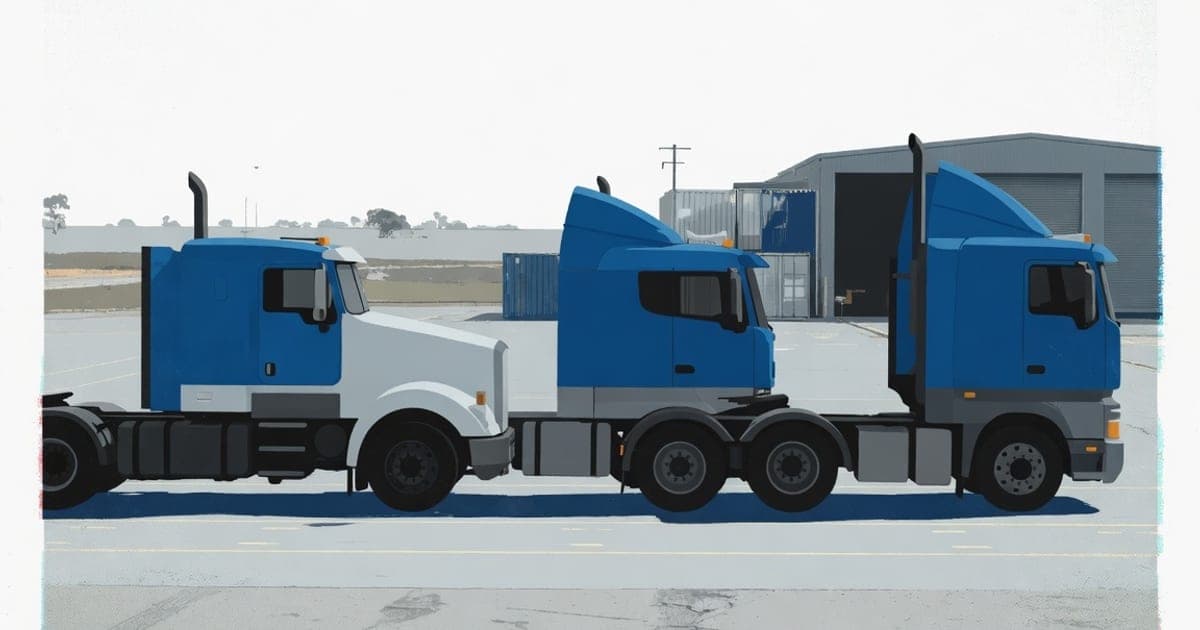
There is no winner in the Kenworth versus Volvo versus Scania argument, because the three trucks are answers to different questions. Kenworth sells a long-life, build-to-order conventional that the Australian market treats as a store of value. Volvo and Scania sell safety-led, automated-transmission cab-overs that fleets buy on whole-of-life cost and drivers increasingly prefer for metro and single-trailer work. Which one suits you depends on the work, the drivers you can get, the distance to the nearest parts counter, and how much of your money you need back at resale. This post compares market positions, not mechanical reliability, and it says so plainly where the evidence runs out.
The real question behind the comparison
Nobody cross-shops these trucks on a spec sheet. The real questions are: will it hold value, can I get it fixed where I operate, will my drivers stay in it, and does it legally and practically suit the combination I pull. Those four questions sort the badges out quickly, and the answers are different for a Brisbane metro fleet than for a Perth to Darwin roadtrain operator.
Conventional vs cab-over: what changes
The bonneted Kenworth puts the driver behind the front axle with an engine tunnel in front. The cab-over Europeans put the driver on top of the engine with a flat floor and a shorter overall tractor length.
- Length and the load. A shorter tractor leaves more combination length for trailer within the legal envelope, which is one reason cab-overs dominate some B-double work. Overall length limits are set under the heavy vehicle dimension rules administered by the NHVR, and axle spacing interacts with mass limits, so the badge decision is partly a compliance decision. Before you commit to a configuration, read how general mass limits work across axle groups, because the rules changed on 1 August 2026 and a tractor that suited the old numbers is not automatically the right choice under the new ones.
- Ride and access. The conventional generally rides better on rough country roads and is simpler to climb around for daily checks. The cab-over wins on manoeuvrability, vision at intersections and cab access in tight yards.
- Sleeper life. Big American sleepers remain the benchmark for genuine weeks-away linehaul. European sleeper cabs have closed much of the gap and beat older American cabs on insulation and noise.
Kenworth: what you pay for
Kenworth's position in Australia rests on three things: a truck specced line-by-line for the job at order time, a deep national dealer and parts network, and resale strength. In our scan of advertised prices on trucksales.com.au and machines4u.com.au in early August 2026, comparable-age Kenworths consistently asked more than European equivalents, often by tens of thousands of dollars, and the gap widens with age. The market, in other words, believes the truck lasts, and prices that belief in.
What you give up is purchase price, some driver comfort features that are standard on the Europeans, and, on manual trucks, access to the shrinking pool of drivers who can use a Roadranger properly. Owner commentary on Australian trucking forums consistently praises longevity and repairability while conceding the Europeans are easier places to spend a shift. Treat that as market perception, consistently reported, rather than measured fact.
Volvo and Scania: safety, driveline and the AMT question
Volvo and Scania sell an integrated package: their own engine, their own automated gearbox, their own diffs, their own electronics. The case for it is fuel economy, safety systems and a truck any competent driver can drive smoothly on day one. The case against it is that an integrated driveline tends to steer major repairs toward the dealer network, a trade-off owner-operators on forums raise repeatedly, and one you should weigh by distance to your nearest dealer rather than by anecdote.
The automated manual transmission is now the default in this part of the market, and driver availability is the argument that decides most fleet purchases. If you are weighing a manual truck against an AMT, the trade-offs, including the licence condition issue that catches people at test time, are covered in Roadranger versus automated manual.
Between the two Swedes, the honest observation from the used market is that both turn over in large fleet volumes, which keeps used supply deep and asking prices competitive. Claimed differences in reliability between them are not something the public evidence settles, and this post will not pretend otherwise.
Mack, Western Star, DAF and the rest
Mack occupies ground close to Kenworth in vocational, tipper and roadtrain work, with a strong following and Volvo group underpinnings in the driveline. Western Star trades heavily on driver appeal in the owner-driver market. DAF, Mercedes-Benz, MAN, Iveco, Freightliner, plus Isuzu, UD and Fuso at the lighter end, generally offer the cheapest entry into a given age bracket. The pattern in advertised pricing is consistent: the less fashionable the badge, the more truck you get per dollar going in, and the less you get back going out. Neither half of that is a criticism; it depends entirely on whether you keep trucks to a million kilometres or turn them over on a cycle.
Parts and downtime in regional Australia
A truck is only as good as the time it spends moving. Kenworth's dealer network, plus the enormous aftermarket for the American driveline components many of them carry, is the strongest regional story, and it is a genuine operational advantage west of the ranges. Volvo and Scania coverage is strong along the eastern seaboard and capital corridors and thinner beyond them. Before buying any badge, do the specific check: where is the nearest dealer or capable independent to your actual routes, and what do operators in your area say about parts turnaround. That local answer outranks anything written in a national comparison, including this one.
Resale: which badge holds money
From observed asking prices in the August 2026 scan: Kenworth holds the most, Mack and Western Star hold well in their niches, and the European fleet trucks depreciate faster early, then flatten. The flip side is that the fast early depreciation on Volvo and Scania is exactly what makes a three-to-five-year-old example strong buying for a second owner. Where the whole market sits by age band, with figures, is covered in what a used prime mover costs, so those numbers live in one place rather than drifting apart across two posts.
Matching the truck to the work
| Your situation | The honest fit |
|---|---|
| Linehaul B-double, keep the truck long term | Kenworth builds its case on longevity, network and resale |
| Metro and regional single trailer, employed drivers | Volvo or Scania AMT, deep used supply, easy to crew |
| Tipper and dog, vocational | Kenworth or Mack spec'd for the job |
| Roadtrain and remote area | Whichever badge your nearest capable workshop actually supports |
| Tight budget, resale not critical | The unfashionable European badges buy the most truck per dollar |
What is missing from this comparison
Be clear about the limits of the evidence. There is no independent, published Australian teardown data comparing these trucks' service lives, so every reliability claim in circulation traces back to owners, workshops and the manufacturers themselves. This post has used observed asking prices, which are verifiable, and attributed perception where it is perception. Weight the sources accordingly, and weight your own inspection of the actual truck above all of it.
When you are ready to look at real stock, browse the current prime movers listed for sale across all three badges and compare asking prices for yourself. And if the comparison has talked you into changing camps, list your current truck free with honest kilometres, hours and history, because the buyer reading this post is exactly who will be looking at it.
Market observations in this post are drawn from advertised asking prices on trucksales.com.au and machines4u.com.au in early August 2026, typically quoted plus GST.