CML vs HML: How Australian Operators Legally Carry More
5 min read
For years Australian operators had three mass tiers to think about: General Mass Limits for everyone, Concessional Mass Limits for accredited operators, and Higher Mass Limits for road-friendly suspension vehicles on approved networks. That structure changed on 1 August 2026. The NHVR's amended Mass, Dimension and Loading Regulation raised GML to the old CML levels and removed CML entirely, so the concession every accredited operator used to pay for is now the general limit, free. HML survives unchanged and is now the only mass tier above general access, still requiring certified road-friendly suspension, accreditation and network access. Here is what each tier was, what remains, and how the arithmetic looks now.
Everything regulatory in this post is drawn from NHVR pages and fact sheets at nhvr.gov.au, checked on 6 August 2026.
The three tiers, and then there were two
Under the Heavy Vehicle National Law, General Mass Limits are the baseline masses in Schedule 1 Part 2 of the MDL Regulation, available to any compliant vehicle on general access roads. CML and HML both sat above that as exceptions, CML's axle group limits sitting in Schedule 2 of the regulation. The plain-English version of how GML itself works is worth reading first if axle groups and combination caps are new to you.
The NHVR's mass exceptions guidance now states it directly: Concessional Mass Limits were removed on 1 August 2026, because aligning GML with CML made the separate category redundant. HML remains.
What the CML concession actually was
CML let operators accredited under the National Heavy Vehicle Accreditation Scheme run modestly heavier than GML. Per the NHVR's CML guidance, the concession was an increase of up to 5 per cent above GML, capped at a maximum of 1 tonne for a vehicle or combination with an allowable gross mass up to 55 tonnes, and a maximum of 2 tonnes above 55 tonnes. In practice that meant things like a six-axle semi running 43.5 tonnes instead of 42.5, in exchange for holding NHVAS mass management accreditation: documented weighing procedures, records, audits and the accreditation label on the truck.
From 1 August 2026, per the NHVR fact sheet, those masses became the new GML: the tandem axle group limit moved to 17.0 tonnes and the tri-axle group to 21.0 tonnes, with combination increases capped at the same 1 tonne and 2 tonne marks. Mass management accreditation is no longer required just to operate at those masses, though the NHVR notes accreditation can still be a condition of some access schemes, such as certain Class 3 notices, and of HML.
If your accreditation existed solely to hold CML, that is a real question for your renewal: the thing it bought you is now free. If it also underpins HML access or customer requirements, it still earns its keep.
Higher Mass Limits: what is still on the table
HML is the remaining way to carry more than general limits, and the NHVR's HML guidance sets out the deal. The headline figures on the NHVR's HML page: tri-axle groups may run 22.5 tonnes under HML against 21.0 under the new GML, tandem groups 17.0 tonnes, six-tyred tandems 14.0 tonnes, and single drive axles on complying buses 10.0 tonnes.
Notice what the 1 August 2026 change did to that comparison. HML tandem and GML tandem are now the same 17.0 tonnes, so for tandem groups HML no longer adds anything. The live HML gain is concentrated in the tri-axle group, 1.5 tonnes per group, which is why HML remains most interesting for semi-trailers, B-doubles and anything else rolling on tri-axle groups. That reading is ours, derived from the two NHVR pages side by side, so confirm it against the current tables before you build a business case on it.
The conditions attached to HML
| Requirement | Detail, per NHVR |
|---|---|
| Road-friendly suspension | Certified against the Department of Infrastructure's Vehicle Standards Bulletin 11 |
| Accreditation | NHVAS mass management accreditation, with the label displayed on the hauling unit |
| Telematics in some states | NSW requires enrolment in the Intelligent Access Program or the Telematics Monitoring Application; Queensland mandates TMA, having removed the IAP option in June 2024 |
| Network access | HML applies only on approved routes, published through the NHVR route planner, with permits needed beyond them |
Two traps hide in that table. First, road-friendly suspension is a certification, not a description: air suspension is usually certified, but you prove it from the plate and paperwork, not by looking at airbags. Second, HML is network access, not a general entitlement, so the routes your freight actually runs decide whether HML is worth anything to you at all. Do not overstate it to yourself when the tri-axle gain is only valuable on corridors you rarely use.
Is it worth it: the commercial arithmetic
The old CML question is dead: that payload is now everyone's. The HML question survives and is straightforward to frame. On the gain side, extra payload per trip on eligible routes, concentrated in tri-axle groups. On the cost side: accreditation fees and audit time, telematics hardware and subscriptions where mandated, the discipline of running the mass management system properly, and buying or keeping equipment with certified road-friendly suspension.
The arithmetic works best for operators running consistent corridors with mass-limited freight, where an extra tonne and a half per tri-axle group multiplies across every trip, every week. It works worst for operators whose loads cube out before they weigh out, or whose routes are off the HML network. Be honest about which you are before paying for the tier.
How this changes what trailer you buy
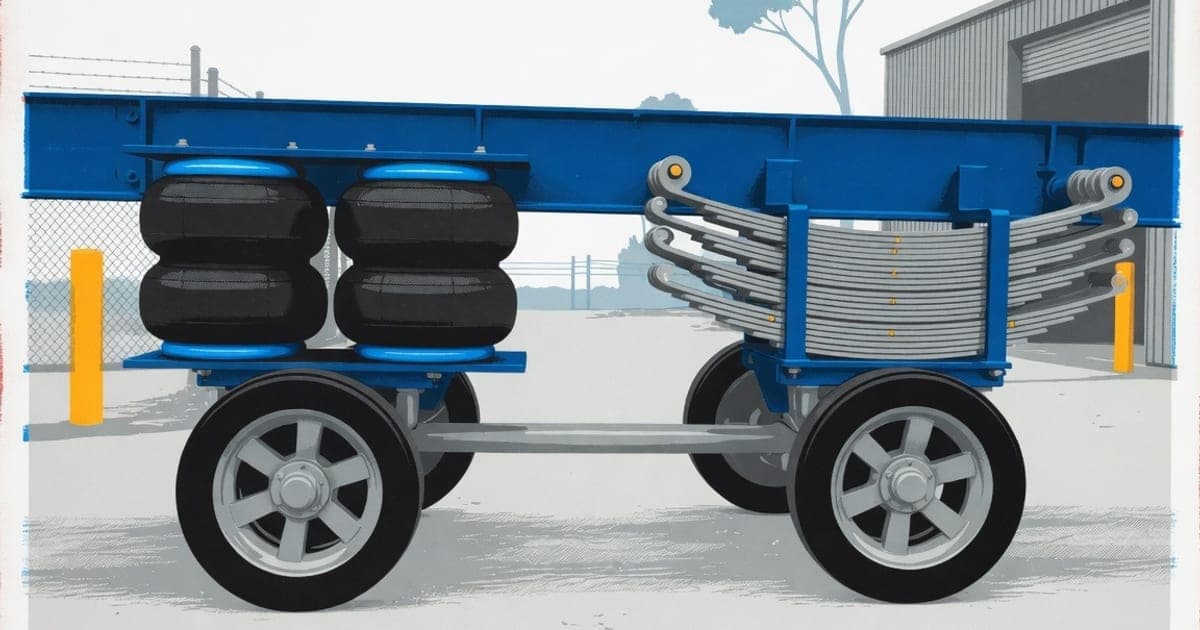
Mass tiers are ultimately a trailer speccing question. Certified road-friendly air suspension keeps the HML door open for the trailer's whole service life, which is a resale argument as much as an operational one, and the difference between spring and air is covered properly in air versus spring suspension for trailers. Axle configuration matters just as much: with the tri-axle group carrying the only remaining HML premium, the tri-axle semi remains the default workhorse, and what the market charges for one is covered in what a used semi-trailer costs.
When you are weighing up a specific trailer, check the suspension certification evidence like you would check rego papers, and treat missing paperwork as missing value. Browse trailers for sale with the mass tier you actually run in mind, and if the 1 August changes have made a trailer in your fleet surplus to the story, list it free with the suspension certification photographed; the next HML operator is searching for exactly that evidence.
Checked against NHVR guidance on 6 August 2026, including the mass exceptions and HML pages and the Mass, Dimension and Loading changes fact sheet for the amendments commencing 1 August 2026. Mass rules and access networks change, and WA and the NT sit outside the HVNL; confirm the current position with the NHVR or your state authority before relying on this.